
![The ROI of Penetration Testing [Formula & FAQs]](https://forgepath.com/wp-content/uploads/2025/09/roi-penetration-testing-hero-image.jpg)
The ROI of Penetration Testing: Key Takeaways
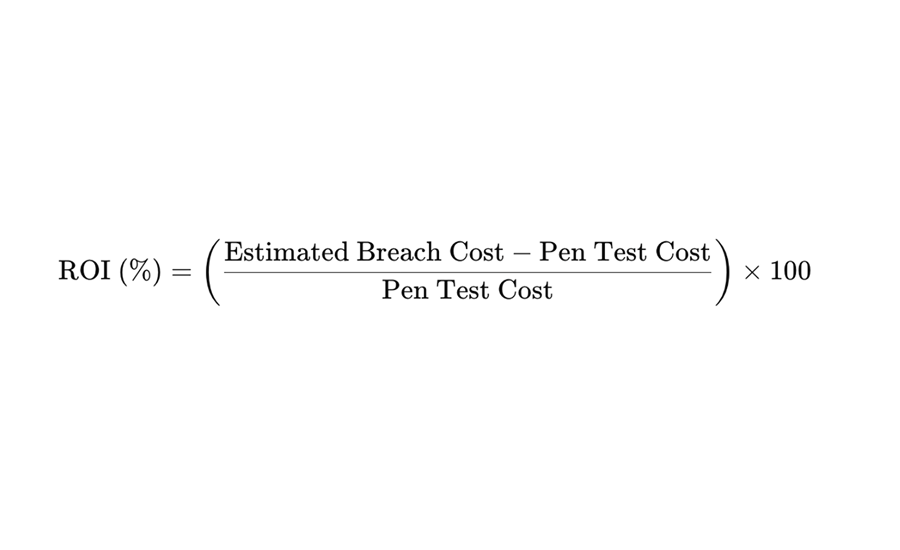
- To calculate penetration testing ROI, subtract the test cost from the estimated breach cost, divide by the test cost, and multiply by 100
- The more dynamic your environment (think new apps, cloud moves, policy changes), the more frequently you need to test
- Pen testing strengthens compliance, minimizes downtime, and boosts stakeholder trust
In 2024, IBM reported the global average cost of a breach reached $4.4 million.
That figure includes legal fees, forensic investigations, and lost business.
Penetration testing costs a fraction of what a breach could, yet it helps you catch critical vulnerabilities early, making it one of the most cost-effective security investments you can make.
If you need help getting leadership on board with pen testing, this guide has you covered.
We will:
- Share a sample formula to compare testing costs with the potential financial impact of a breach
- Discover how pen testing supports compliance and reduces downtime risk while protecting your brand and bottom line
- Explore why Forgepath is a trusted testing partner
How Do You Calculate the ROI of Penetration Testing?
Return on investment (ROI) is a measure of how much value you get compared to what you spend.
The higher the ROI, the better the return – which makes the investment easier to justify.
We’ll walk you through the calculation so you can make a clear, data-backed case for investing in penetration testing.
1. Start With the Cost of a Breach
Begin by gathering data from recent industry reports, breach databases, or internal risk models to estimate what a security incident could realistically cost your organization.
Focus on direct and indirect expenses such as:
- Legal fees, including external counsel and litigation costs
- Regulatory fines from frameworks like HIPAA, PCI DSS, or GDPR
- Operational downtime, especially for critical services or platforms
- Customer churn and lost revenue following the incident
- Brand damage, including PR response and long-term trust erosion
2. Add Up the Cost of a Penetration Test
Next, calculate the total investment required to run a meaningful pen test. This includes more than just the vendor’s invoice:
- External testing fees, based on scope, duration, and methodology
- Internal team time, including coordination, support, and remediation follow-up
- Retesting or validation to confirm that vulnerabilities have been properly fixed
3. Calculate the ROI
Now plug the numbers into the formula:
5 Benefits of Pen Testing
Quantifying cybersecurity ROI isn’t always straightforward, but when framed around risk, uptime, and compliance, penetration testing proves its value.
1. Reduce Breach-Related Costs
A data breach isn’t just a hypothetical threat. It comes with real, measurable costs.
Penetration testing, at a fraction of the cost, helps you catch critical vulnerabilities early and avoid that kind of financial hit.
2. Improve Compliance Readiness
Many regulations, including HIPAA, PCI DSS, and SOX, now require or recommend regular security testing.
Falling short doesn’t simply raise your risk of a breach. It also opens the door to fines and legal trouble.
Pen testing can help you stay compliant, and it shows regulators that you’re doing your part to protect critical systems and data.
3. Minimize Downtime Risk
Cyberattacks often shut down critical systems. For industries like finance or eCommerce, every hour offline means lost revenue and customer trust.
Testing before peak business periods such as tax season or holiday sales helps fix vulnerabilities early and avoid expensive outages.
4. Build Stakeholder Trust
Breaches can leave lasting damage, especially to your reputation.
Just look at Ticketmaster. In May 2024, attackers exploited a third-party cloud vulnerability and exposed data from over 560 million customers.
Names, emails, phone numbers, and partial payment details were leaked, shaking user trust and tarnishing the brand worldwide.
Regular testing helps prevent incidents like this and shows stakeholders that you’re actively protecting what matters most.
5. Maximize Your Security Budget
Pen test results help identify what’s working and what isn’t.
That insight allows you to:
- Reconfigure underperforming tools
- Prioritize high-impact fixes
- Focus your security budget where it matters most
Common Pen Testing Myths That Hurt ROI
There’s a lot of confusion around what penetration testing does (and doesn’t) do.
Let’s clear a few things up.
Myth #1: “We’re too small to be targeted.”
Let’s be honest. Attackers don’t care about your company size. They care about access, data, and opportunity.
Small and midsized organizations often have fewer defenses, which makes them easier targets. Pen testing helps you find those weaknesses before someone else does.
Myth #2: “We passed our compliance audit, so we’re good.”
A pen test simulates real-world attacks to show you how an adversary could actually break in, not just whether your paperwork is up to date.
Myth #3: “Our internal team can handle everything.”
Your internal team knows the systems better than anyone. And surprisingly, that’s the problem. Familiarity creates blind spots that only an outside tester will notice.
A third-party pen tester brings fresh perspective, specialized tools, and tactics your team may not see day-to-day.
Which Industries Should Invest in Penetration Testing?
Penetration testing isn’t just for highly regulated or tech-heavy sectors anymore. Any industry handling sensitive data, critical infrastructure, or digital services should make it a priority.
That said, some industries face a higher risk profile and stand to benefit the most from regular testing:
1. Healthcare
Hospitals, clinics, and providers handle protected health information, making them prime targets for ransomware and data theft.
Regulations like HIPAA demand strong controls and the stakes often go beyond financial loss.
2. Financial Services
Banks, fintech platforms, and insurance companies deal with high-value transactions and sensitive personal data.
3. Retail and eCommerce
Retailers handle large volumes of payment data and depend heavily on web apps and third-party platforms.
During peak shopping periods like Black Friday, that reliance becomes a liability.
Penetration testing helps retailers identify vulnerabilities early, reduce downtime risks, and ensure compliance with PCI DSS.
4. Manufacturing & Industrial
Connected systems make modern factories more efficient. However, they also open new doors for attackers.
From robot control systems to SCADA environments, cyber threats now reach deep into the production floor.
One breach could stop operations, damage critical equipment, or even put workers at risk.
5. Technology & SaaS
For cloud providers and SaaS vendors, one vulnerability can impact hundreds of customers. Penetration testing helps catch those issues early and shows clients you take their security seriously.
6. Education
Colleges and K–12 schools handle sensitive data in scientific research and student records but often lack the resources for bullet-proof cybersecurity.
That makes them an easy target, especially during busy times like enrollment or exams.
Penetration testing helps uncover gaps before attackers can exploit them.
7. Government
Government agencies are responsible for everything from Social Security records and tax systems to emergency services and power grids.
That makes them attractive targets for both cybercriminals looking for financial gain and nation-state actors aiming to disrupt public infrastructure.
With limited budgets and mission-critical systems at stake, regular penetration testing can help identify vulnerabilities before they’re exploited.

How Often Should You Run a Penetration Test?
Not sure when to test? These key factors will help you decide.
1. Your Risk Profile
If your organization handles sensitive data, relies on public-facing systems, or operates in a high-risk industry like finance or healthcare, you should test more frequently, typically at least twice a year.
A proper risk assessment can highlight where you’re most exposed and guide your testing schedule.
2. Compliance Requirements
PCI DSS explicitly requires penetration testing at least once a year or after any significant changes to your environment.
Other frameworks, like HIPAA and SOC 2, may not mandate regular testing but strongly encourage it as part of continuous security oversight.
In most cases, your industry and compliance needs will set the minimum testing frequency.
3. Major Changes to Systems or Infrastructure
You should schedule a new pen test any time you:
- Launch a new application
- Migrate apps or data to the cloud
- Make a significant change to your network or policies
Even minor updates can introduce new vulnerabilities that won’t be caught unless you test again.
Why Choose Forgepath as Your Penetration Testing Partner
When conducting a pen test, collaborate with a partner who works closely with your team, understands your compliance goals, and helps you improve your security in ways that actually make a difference.
At Forgepath:
- We test like real attackers: We don’t just run automated scans. We simulate real-world attacks using the same tactics threat actors use in the wild so you get a realistic view of your exposure.
- We know your industry: Whether you’re in healthcare, finance, government, or retail, we tailor every engagement to your specific risks and regulatory needs.
- Our reports are clear and actionable: You won’t get a long report full of technical jargon. We deliver clear findings, prioritize the most critical issues, and provide steps your team can act on right away.
- We verify your fixes: Remediation is only half the job. That’s why we include retesting to confirm vulnerabilities are truly resolved.
- We stick around to support you: We don’t disappear after the report is delivered. We help you interpret results, support your remediation efforts, and prep for audits or stakeholder briefings.
Ready to talk about your security goals? Schedule a quick call with one of our experts to see how Forgepath can help you tackle your biggest cybersecurity challenges head-on.
The ROI of Penetration Testing: FAQs
Is pen testing really worth it for smaller companies?
Yes. Smaller organizations are often easier targets, as they usually don’t have the same security resources as larger enterprises.
And it only takes one breach to cause serious financial and operational damage.
Whether you work at a dynamic startup or a Fortune 500 company, it only takes one missed vulnerability to cause real damage. Pen testing lets you catch it before an attacker does.
How does penetration testing actually deliver ROI?
It helps you avoid costly problems before they happen. By identifying real risks, supporting compliance, and guiding smarter security spending, pen testing prevents incidents that could cost millions.
When can I expect to see ROI from penetration testing?
You can start seeing ROI as soon as the findings lead to meaningful action like fixing a critical vulnerability, passing an audit, or avoiding an operational disruption.
In many cases, the value is immediate:
- You catch and fix a high-risk issue before it’s exploited
- You avoid non-compliance penalties
- You reduce downtime during peak operations
- You tighten your security roadmap based on real data
