


Secure Code Review: Key Takeaways
- Secure code review is the systematic analysis of software source code to identify and fix security vulnerabilities
- Security flaws often enter code during development due to insecure coding practices and lack of security awareness or training
- The process includes four key phases: defining review objectives, executing the review, documenting findings, and remediating and verifying fixes
Did you know some cyber threats don’t occur during production?
Verizon’s 2026 DBIR found that 31% of breaches start with an exploited vulnerability, and many of those flaws are introduced as early as the development stage, where they’re easier to overlook.
So, how can you catch these threats early?
In this guide, we will:
- Cover the root causes of software vulnerabilities
- Identify the most common security risks introduced during development
- Break down the secure coding process
- Discover how Forgepath’s secure code review services help improve your security posture and reduce risk
What Causes Security Vulnerabilities in Software Development?
Security flaws often make their way into code during development due to:
- Insecure coding practices, such as failing to validate input, hardcoding credentials or API keys, and improper error or exception handling.
- Lack of security training or awareness among developers, who may not be familiar with secure coding principles, secure design patterns, or threat modeling techniques.
- Time pressure and tight deadlines, which can lead to skipped code reviews, reduced testing, or ignoring security best practices in favor of shipping quickly.
- Growing codebase complexity, which makes it more difficult to enforce consistent security controls and maintain visibility across interconnected components and services.
- Use of third-party libraries or dependencies, especially open-source packages that may include known, unpatched, or zero-day vulnerabilities.
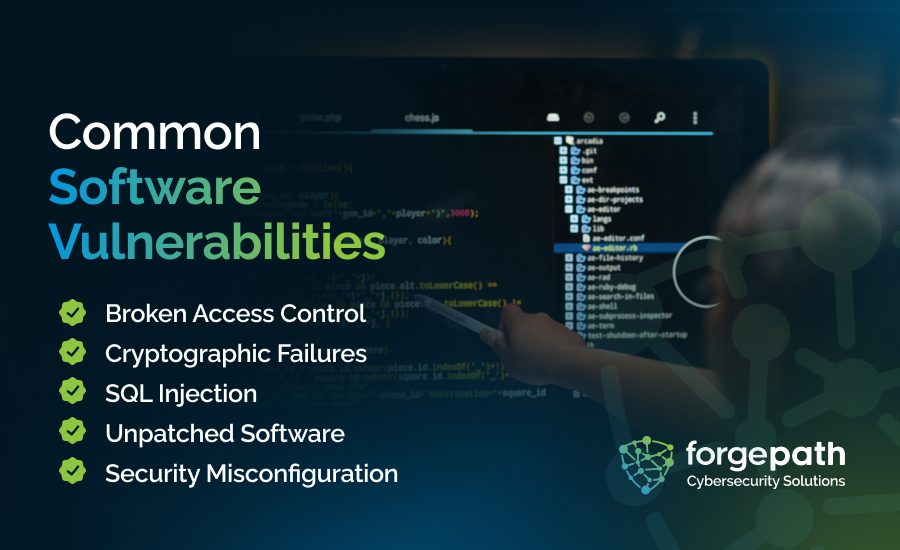
10 Common Software Vulnerabilities Introduced in Development
Software vulnerabilities are often introduced during development due to human error, insecure coding practices, and neglecting security early in the software development lifecycle.
1. Broken Access Control
Broken access control occurs when an application fails to restrict user permissions properly, allowing unauthorized access to data or actions.
This can lead to information disclosure, data manipulation, or data deletion.
2. Cryptographic Failures
Formerly known as sensitive data exposure, cryptographic failures occur when systems fail to protect sensitive data due to weaknesses in their cryptographic mechanisms.
These failures can lead to unauthorized access or data breaches.
3. SQL Injection
A study found that SQL injection was the leading cause of critical web application vulnerabilities globally in 2023.
SQL injection occurs when untrusted input is treated as a database query, allowing attackers to manipulate backend SQL commands.
This common attack vector can expose sensitive data such as user credentials, customer records, or proprietary business information.
4. Unpatched Software
Unpatched software often enters development when teams rely on outdated or vulnerable third-party components, such as libraries, frameworks, plugins, or APIs, without applying the latest security patches.
These overlooked vulnerabilities leave a wide window of exposure.
Attackers routinely scan systems running known, unpatched software, making them prime targets for unauthorized access, remote code execution, privilege escalation, and data theft.
In fact, Verizon’s 2026 DBIR found that exploiting vulnerabilities is now the top way into breaches, at 31%, proving how costly delayed patching can be.
5. Security Misconfiguration
This software vulnerability encompasses poorly configured applications, servers, or security settings, such as open cloud storage, verbose error messages, or unnecessary services running in production.
6. Vulnerable and Outdated Components
Outdated or unpatched libraries directly lead to known vulnerabilities, many of which attackers are already exploiting.
To stay secure, teams should regularly update dependencies, monitor CVE disclosures, and use tools like software composition analysis (SCA) to catch risks before they reach production.
7. Identification and Authentication Failures
These vulnerabilities stem from weak or poorly managed authentication systems like default passwords, insecure credential storage, broken session handling, or faulty multi-factor authentication (MFA) setups.
Attackers routinely exploit these gaps to hijack accounts, impersonate users, and gain unauthorized access to sensitive systems.
8. Software and Data Integrity Failures
Software and data integrity failures occur when systems can’t reliably prevent unauthorized changes to code, configuration, or data.
These weaknesses often stem from insecure software supply chains or lax validation practices, giving attackers an opportunity to inject malicious updates, alter scripts, or corrupt critical data.
9. Security Logging and Monitoring Failures
Security logging and monitoring failures happen when systems fall short in capturing, analyzing, or responding to security events, leaving organizations blind to active threats.
Missing or incomplete logs, weak real-time monitoring, or unprotected log data can delay detection, hinder incident response, and allow breaches to go unnoticed.
10. Server-Side Request Forgery (SSRF)
SSRF is a vulnerability that allows attackers to trick a server into sending requests to internal or unintended destinations.
This often occurs when an application accepts user input, like a URL, and uses it to perform server-side requests without properly validating it.
If exploited, SSRF can expose internal services, leak sensitive data, or even lead to remote code execution in more severe cases.
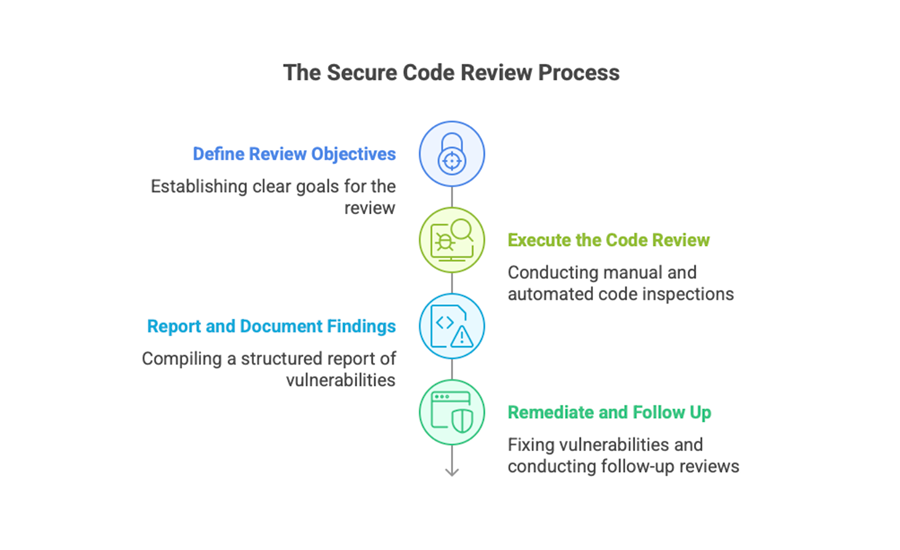
The Secure Code Review Process
When executed effectively, a secure code review process can help teams detect and eliminate vulnerabilities early, reduce technical debt, and improve long-term application resilience.
1. Define Review Objectives
Every effective code review starts with a clear purpose.
What types of vulnerabilities are most relevant to the application? Which modules carry the most risk?
Establishing these objectives ensures the review is focused and aligned with the project’s threat model.
This stage also involves understanding the application’s architecture, data flows, and business logic.
With that foundation, reviewers can define a clear scope and prioritize high-risk code paths, whether they involve authentication, data processing, or external integrations.
2. Execute the Code Review
The execution phase is where the actual review is conducted. It can include:
- Manual code inspection: Carefully examining the code at a granular level to detect flaws like insecure session handling, injection points, and authorization weaknesses.
- Automated scanning: Using static analysis tools to flag known patterns of insecurity, such as cross-site scripting (XSS) or insecure cryptographic functions.
3. Report and Document Findings
Following the review, create a detailed report that documents vulnerabilities, prioritizes them by severity, and provides recommended solutions.
Clear documentation helps developers quickly understand and resolve issues. Even when using automated tools, human validation is essential to eliminate false positives and ensure accuracy.
These reports guide remediation and serve as valuable references for audits, compliance, and ongoing security assessments.
4. Remediate and Follow Up
Fixing vulnerabilities, not just finding them, is what ultimately improves security.
The development team prioritizes, resolves, and thoroughly tests each issue. Then, they can conduct a follow-up review to confirm the fixes are effective and haven’t introduced new risks, closing the loop and strengthening the application’s overall security.
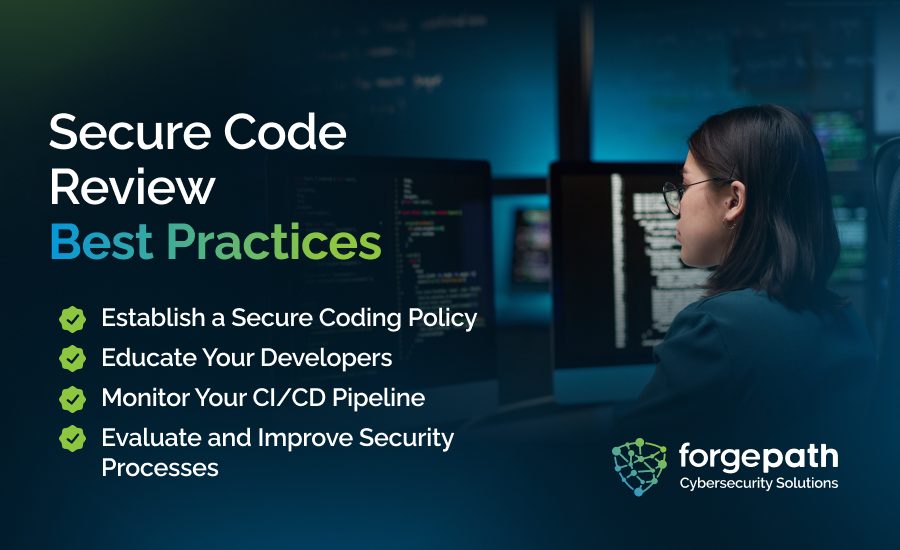
Best Practices for Secure Code Review
Implementing secure code review best practices helps teams catch vulnerabilities early, improve code quality, and strengthen overall application security.
1. Define and Maintain a Secure Coding Policy
A secure coding policy defines clear, enforceable standards for safe development.
It should outline principles and address key areas like input validation, error handling, data protection, and secure logging.
Tailor the policy to your tech stack and risk profile.
For example, if you’re processing PII, mandate encryption standards and access controls. Update the policy regularly to reflect evolving threats, frameworks, and compliance requirements.
2. Train Developers in Secure Coding
Train developers to recognize and prevent vulnerabilities during coding to ensure security is built early, and costly risks are avoided down the line.
Also, emphasize a security-first mindset, so developers think defensively by default.
Training should be:
- Regular: Offer sessions on current threats, new tools, and OWASP Top 10 vulnerabilities.
- Practical: Include hands-on exercises like code review simulations and secure coding labs.
- Flexible: Provide on-demand resources, for example, internal wikis, webinars, and curated learning paths.
3. Secure the CI/CD Pipeline
CI/CD pipelines are high-value targets for attackers, especially when they’re misconfigured, use default credentials, or expose sensitive endpoints.
Securing the pipeline is essential to preserving code integrity, safeguarding secrets, and preventing unauthorized deployments to production environments.
Safeguard them by:
- Restricting access to pipeline tools, credentials, and secrets
- Using secure defaults in deployment configurations
- Regularly scanning CI/CD tools for vulnerabilities
Automate security checks with:
- SAST to catch vulnerabilities in source code and configurations during the build phase
- DAST to test running applications for runtime security flaws, such as broken access control
These tools reduce manual overhead and detect issues before code reaches production.
4. Review and Evolve Security Practices
Continuously evaluate and refine your secure coding process. Schedule regular:
- Audits of coding policies and CI/CD controls
- Assessments of training effectiveness
- Updates based on threat intelligence and vulnerability trends
Foster team learning through retrospectives, security demos, and peer-led sessions to keep secure coding practices aligned with business and technical goals.
Explore Secure Code Review Services at Forgepath
At Forgepath, we ensure security starts at the source code.
Our secure code review service is a tactical layer of defense designed to identify vulnerabilities before they become cyber threats.
Whether you’re developing new software or managing legacy systems, our experts deliver in-depth, manual code reviews to identify security flaws like injection risks, broken authentication, and misconfigurations.
Our approach is not just about checking boxes; it’s also about understanding your business logic, development practices, and tech stack to provide actionable insights that developers can use right away.
Secure Code Review: FAQs
1. What is a secure code review?
Secure code review involves manually or automatically analyzing an application’s source code to uncover security vulnerabilities.
The process focuses on identifying logic flaws, validating implementation against security specifications, and spotting deviations from secure coding standards.
2. When should I perform a secure code review?
Perform secure code reviews during key development milestones:
- Before major releases
- During code handoffs or audits
- After significant changes or refactoring
- As part of your DevSecOps pipeline
3. Why do I need a secure code review if I already use automated scanners?
Automated scanners often miss context-specific flaws and generate false positives.
A manual or hybrid secure code review adds human judgment to catch complex business logic errors and subtle vulnerabilities that scanners typically overlook, delivering stronger assurance.
