


Privileged Access Management: Key Takeaways
- Privileged access management (PAM) is a cybersecurity discipline that controls and monitors elevated access across users, accounts, systems, and processes
- Types of privileged accounts include local admin accounts, domain admin accounts, and application accounts
- Benefits of privileged access management include reducing the risk of malware infections, improving operational safety, and simplifying compliance and auditing
Did you know that 33% of organizations in a 2024 Identity Defined Security Alliance survey reported a compromised privileged identity?
These high-value accounts are a goldmine for attackers, offering direct access to critical systems, sensitive data, and full administrative control.
Just one compromised account can unravel your entire security posture.
That’s why PAM is essential. It gives you the tools to secure elevated access, monitor every privileged action, and stay firmly in control of your most powerful accounts.
In this guide, we’ll cover:
- What privileged accounts are and the different types you need to secure
- The key benefits of implementing privileged access management (PAM)
- Common challenges organizations face when deploying PAM solutions
- How Forgepath’s services can strengthen your security posture
What Are Privileged Accounts?
Privileged accounts are special user accounts that have more access and control over systems than regular user accounts.
These accounts allow users to do things like:
- Change system settings
- Install software
- Manage other accounts
- Perform administrative tasks that standard users can’t, such as modifying security policies, accessing sensitive data stores, or restarting critical infrastructure services
Anyone using one of these accounts is considered a privileged user.
Because privileged users have broader access, their accounts pose a higher risk. If attackers gain access to privileged accounts, they can make significant changes or inflict serious damage.
Types of Privileged Accounts
While most non-IT employees only need standard user access, IT professionals often require elevated privileges.
They typically use a regular account for routine tasks and switch to a superuser account for administrative work.
Because these accounts offer broad system access, they pose a higher security risk if misused.
That’s why a key PAM best practice is for security teams to use privileged accounts only when necessary and limit their use to the shortest time possible.
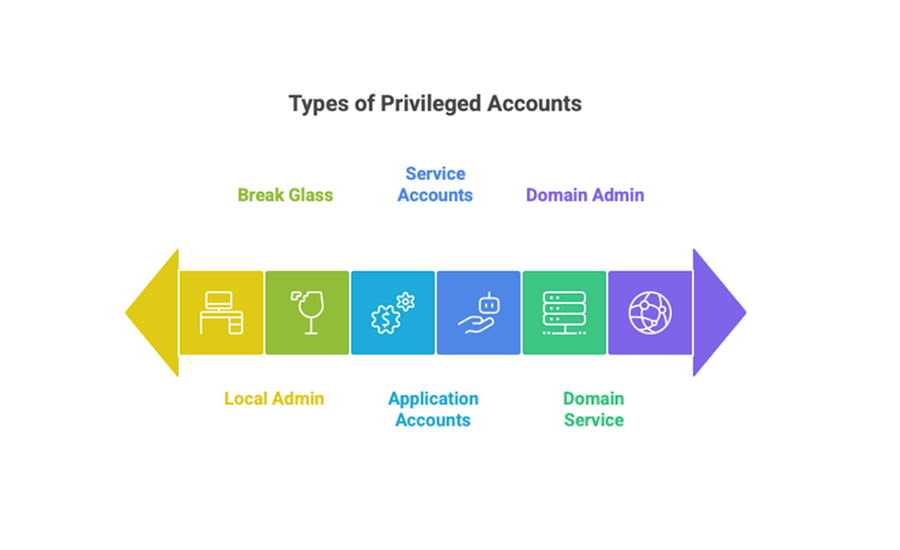
Here are some common types of privileged accounts you’ll find in most organizations:
- Local admin accounts: These aren’t tied to a specific user and provide admin access only to a single local machine or device.
- Domain admin accounts: These allow broad administrative control across all computers, servers, and systems within a company’s domain.
- Break glass accounts (also known as emergency or firecall accounts): These provide temporary admin access in urgent situations to users who wouldn’t normally have it.
- Service accounts: Applications or services use these to interact with the operating system, often requiring elevated privileges.
- Domain service accounts (like those in Active Directory): These manage tasks such as automated password changes and system maintenance across the network.
- Application accounts: Software uses these accounts to access databases, run scripts or batch jobs, and communicate with other applications.
Benefits of Privileged Access Management (PAM) Solutions
Implementing PAM offers a wide range of advantages for both cybersecurity and operational efficiency.
Key benefits include:
1. Reduced Attack Surface
A 2025 report by Fortinet and Cybersecurity Insiders found that 77% of organizations had insider related data loss in the past 18 months, underscoring the growing threat from within.
PAM solutions can help reduce this risk by limiting access to critical systems.
With fewer users holding elevated privileges, the chances of misuse or compromise drop, making insider threat protection a tangible outcome of effective PAM implementation.
2. Lowered Risk of Malware Infections
Many types of malware, like ransomware, need higher-level access to do real damage, such as:
- Installing malicious software
- Encrypting or deleting critical data
- Altering system configurations
When users have only basic permissions, it becomes much harder for malware to install itself or spread across the network.
By enforcing the principle of least privilege, PAM restricts what users can do, even if malware gains a foothold.
This not only limits external exposure but also bolsters insider threat protection by ensuring that internal misuse can’t escalate unchecked.
3. Improved Operational Stability
Keeping elevated access in check helps secure systems while also ensuring smoother, more dependable performance.
When users, applications, and services are restricted to only what they’re authorized to do, there’s less chance of system conflicts, crashes, or costly mistakes.
The result? Fewer disruptions, smoother operations, and stronger uptime across the systems your business depends on most.
4. Easier Compliance and Auditing
Regulatory standards like HIPAA, PCI DSS, SOX, and GDPR require strict oversight of privileged access to protect sensitive data and systems.
PAM solutions support these mandates by enforcing least privilege by default and generating comprehensive audit logs for all administrative activity.
This not only simplifies compliance reporting but also helps organizations avoid fines, legal issues, and reputational damage.
Additionally, federal guidelines, such as NIST’s Zero Trust Architecture guidance, highlight PAM as a core security control, further reinforcing its importance in meeting regulatory expectations.
5. Eligibility for Cyber Insurance Coverage
Cyber insurance providers increasingly require PAM as a condition for coverage.
Insurers now look for evidence of local admin removal, role-based access controls, and credential vaulting as part of their underwriting process.
Insurers might raise premiums, or deny coverage altogether, when organizations lack PAM, especially as ransomware and credential-related breaches continue to surge.
Challenges in Implementing Privileged Access Management
Despite its importance, many organizations struggle to fully secure and manage privileged access.
Common challenges include:
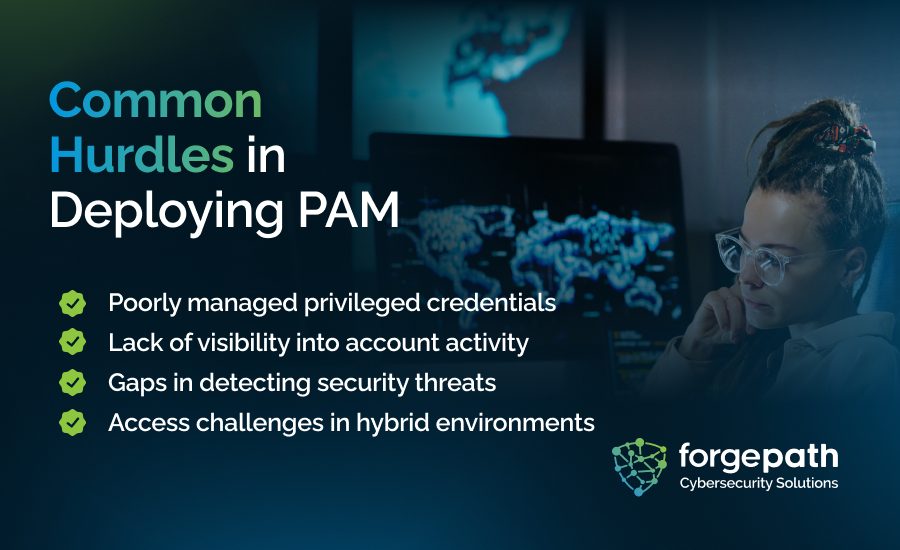
1. Credential Management Inefficiencies
Many IT teams still manage privileged credentials manually; this means updating, rotating, and tracking them by hand.
Not only is this process inefficient, but it also heightens the chances of human error, system exposure, and unnecessary costs.
2. Limited Visibility Into Privileged Activity
Without centralized oversight, organizations often lack the ability to consistently monitor and control privileged sessions.
This blind spot increases the risk of security breaches and makes it difficult to meet regulatory compliance requirements.
3. Inadequate Threat Detection and Response
A lack of advanced analytics and monitoring tools can prevent security teams from spotting unusual or malicious behavior in real time.
This delays incident response and boosts the risk of damage before a threat is contained.
4. Access Control Across Diverse Environments
As businesses expand across cloud services, SaaS platforms, and external channels like social media, managing privileged user access becomes increasingly complex.
Inconsistent controls across these environments can result in compliance issues and operational vulnerabilities.
5. Protecting High-Value Targets Like Domain Controllers
Windows domain controllers are high-value targets because they control authentication across the network.
Attackers often exploit protocols like Kerberos to impersonate users and gain elevated access.
Once compromised, these systems can expose sensitive data and critical infrastructure, making their protection essential to preventing large-scale breaches.
Monitor, Detect & Prevent Unauthorized Privileged Access With Forgepath
Take control of your most sensitive systems with Forgepath’s Privileged Access Management (PAM) services.
We help you secure elevated access, shut down insider threats, and meet compliance requirements with confidence.
From protecting domain controllers to securing hybrid cloud environments, our experts deliver the visibility and precision you need to outmaneuver today’s most advanced attacks.
With Forgepath, privileged access isn’t a risk; it’s a strategic advantage.
And with built-in insider threat protection, you gain peace of mind knowing that your most sensitive accounts are under lock and key.
Privileged Access Management: FAQs
What is privileged access management (PAM)?
Privileged access management (PAM) refers to a set of cybersecurity practices and technologies designed to monitor and control elevated access and permissions across users, accounts, systems, and processes within an IT infrastructure.
By enforcing strict access controls, PAM shrinks the attack surface and helps prevent damage from external threats and insider misuse.
How does privileged access management work?
Privileged access management begins by mapping out which users, systems, and services require elevated permissions, and defining the specific policies that govern that access.
PAM solutions enforce these policies through features like automated credential management, multifactor authentication, and role-based access controls.
Administrators can streamline account creation, modification, and removal by automating these processes, ensuring that access stays tightly aligned with user roles and responsibilities.
What is the difference between a privileged account and a standard account?
A privileged account grants elevated access to perform administrative tasks, such as modifying system settings, installing software, or managing user permissions.
In contrast, a standard account has limited access, typically restricted to using approved applications and files without the ability to make system-wide changes.
PAM vs. PIM
Privileged access management (PAM) focuses on securing and monitoring access to privileged accounts across your environment.
It helps prevent unauthorized access, protects sensitive groups and systems, and gives you visibility into how privileged accounts are used, strengthening your defense against internal and external threats.
Privileged identity management (PIM) is more granular and time-bound.
It enforces just-in-time and just-enough access by requiring approval and limiting the duration of privileged roles.
PIM adds further protection with policies like multifactor authentication to reduce the risk of privilege misuse.
Why is privileged access a high-value target for attackers?
Privileged accounts unlock critical systems and sensitive data.
Attackers target them early to disable defenses, steal information, deploy ransomware, or create persistent backdoors.
What are some best practices for managing privileged access?
Key best practices include:
- Enforcing least privilege, ensuring users have only the access they need
- Using just-in-time access to reduce standing privileges
- Implementing session recording and monitoring for accountability
- Regularly rotating credentials and vaulting passwords
- Requiring multifactor authentications for all privileged actions
Can you implement PAM in cloud environments?
Yes. Modern PAM solutions support hybrid and multi-cloud environments.
They can manage privileged access to infrastructure-as-a-service (IaaS), SaaS platforms, and cloud-native workloads by integrating with identity providers, APIs, and cloud IAM tools.
How does PAM help with regulatory compliance?
PAM enables compliance with standards like HIPAA, PCI DSS, SOX, GDPR, and NIST 800-53 by:
- Enforcing access control policies
- Generating detailed audit logs
- Supporting user accountability
- Preventing unauthorized access to sensitive systems
