Green decoration

AI Security Services

Forgepath helps you adopt AI with confidence. We provide AI security solutions that reduce risks from misuse, data leakage, and shadow AI while aligning your program to NIST AI RMF, ISO/IEC 42001, or the EU AI Act, so innovation keeps moving.
Artificial Intelligence Security
Blue decoration

Why AI Cybersecurity Solutions Are Critical Today

AI is evolving faster than most governance programs can keep up. Teams are experimenting, tools and agents are multiplying, and sensitive data often ends up in unintended places. Without clear policies, guardrails, and validation, organizations face risks from prompt injection, model abuse, insecure plugins, and unmonitored shadow AI.

At the same time, new regulations like NIST AI RMF, ISO/IEC 42001, and the EU AI Act are raising expectations for trustworthy AI. Forgepath delivers Artificial Inteligence security solutions that bring structure, safety, and speed so you can innovate without blind spots.

78 %

of employees use their own AI tools at work (BYOAI), increasing shadow-AI risk and data exposure.

27 %

of organizations have temporarily banned GenAI due to privacy and security concerns.

48 %

of organizations report employees have entered non-public data into GenAI tools, heightening leakage and compliance risk.

20

U.S. states now have comprehensive privacy laws — raising governance expectations for AI data.

Need an expert?

Deploy Full-Scope AI Security and Governance Solutions

Whether you build AI products, connect LLMs to enterprise data, or roll out company-wide policies, Forgepath delivers artificial intelligence services that cover the tactical, strategic, professional, and managed layers of AI security.

accordion-icon Tactical Services

AI Penetration Testing

We test LLM and AI-enabled applications the way attackers do, including prompt and indirect injection, data-exfil paths through tools and connectors, insecure output handling, and authorization bypass risks. With our artificial intelligence security approach, you get validated abuse paths and practical guardrail tuning that improves safety without blocking the business.

AI Disinformation Testing

We evaluate how your systems handle malicious or manipulative inputs, misinformation patterns, and brand-impersonation attempts. The result is clear guidance to reduce harmful outputs and build trust in your AI experiences.

Secure Code Review

We review the code that integrates models, prompts, retrieval pipelines, and plugins/APIs for issues like injection, data handling mistakes, secrets exposure, and dependency risks. You receive targeted fixes and secure-by-default patterns developers can apply immediately.

accordion-icon Strategic Services

AI Governance

We help you define policies, roles, acceptable-use rules, and model inventories so AI is adopted safely and consistently. Expect practical controls that fit how your teams work, not just paperwork.

AI Risk Management

Using NIST AI RMF 1.0, we identify AI risks, rate impact and likelihood, and map them to specific controls and monitoring. You get a living risk register and a clear plan to reduce risk while keeping momentum.

AI Trust Index Assessment

We baseline your AI program against pillars like safety, robustness, transparency, privacy, and accountability. You get an easy-to-understand score and prioritized actions that raise trust with users, regulators, and stakeholders.

Frame 43 Professional Services

AI Security Education

Hands-on training for builders and business teams covering secure prompting, misuse risks, data protection, and safe deployment patterns. We tailor sessions so people leave confident and ready to apply what they learned.

Frame 43 Managed Security

CAIO as a Service

A fractional Chief AI Officer function that brings governance, architecture oversight, vendor and model selection guidance, and program metrics. You get ongoing leadership that keeps AI safe, useful, and aligned with your goals.

OUR VALUED PARTNERS
Logo-ZeroHealth
Logo-Draftkings
Logo-Solverone
Logo-MarketBasket
Logo-SFMLP
Logo-OceanDowns
Logo-YHBCPA
Logo-AdventKnows
Logo-ParallelSystems
Our Seven-Step Framework

Our AI Security Solutions & Governance Methodology

Our process unifies governance consulting and adversarial testing. We align to NIST AI RMF 1.0, ISO/IEC 42001, and OWASP Top 10 for LLMs; map real harms and misuse paths; and validate what matters through policy and control assurance or hands-on testing where appropriate. With Forgepath’s AI cybersecurity solutions, every engagement ends with prioritized actions, enablement, and re-testing of critical technical findings.

Step 1

Define Purpose, Scope & Success Criteria

Align stakeholders on objectives, boundaries, and measurable outcomes

We clarify your AI use cases, risk tolerance, compliance drivers, and what “good” looks like. This sets the shared objectives for both governance and technical work.

Goals For this Phase:

  • Confirm business objectives, in-scope systems, data, and teams
  • Capture regulatory/contractual drivers and decision criteria
  • Establish risk appetite and success metrics tied to outcomes
  • Set timelines, stakeholder map, communication plan, and change windows
1
Step 2

AI Inventory & Data-Flow Mapping

Make the invisible visible—catalog models, data, tools, and flows

We catalog models, prompts, datasets, tools/plugins, RAG pipelines, agents, and integrations—plus where sensitive data moves and who can access it.

Goals For this Phase:

  • Build a current, accurate model/application and provider inventory
  • Visualize data flows, trust boundaries, and cross-tenant movement
  • Identify high-value assets, regulated data, and exposure points
  • Flag high-risk use cases that need additional guardrails
6
Step 3

Risk Modelling

Prioritize realistic harms and misuse paths across your AI system

Using AI-specific threat models, we analyze misuse/abuse scenarios (e.g., prompt/indirect injection, data exfiltration, model abuse), safety/ethics concerns, privacy impacts, and supply-chain risk.

Goals For this Phase:

  • Prioritize plausible harms and attack paths by impact and likelihood
  • Map risks to controls from AI RMF/42001/OWASP (and privacy obligations)
  • Define concrete test cases/tabletops for validation
  • Establish a living risk register with owners and review cadence
5
Step 4

Control Baseline & Governance Design

Translate policy into practical, enforceable controls and roles

We baseline current policies and controls (acceptable use, human-in-the-loop, approvals, logging/monitoring, model lifecycle, vendor due diligence) and design practical updates your teams can adopt.

Goals For this Phase:

  • Assess governance maturity against recognized frameworks
  • Define roles/RACI, operating procedures, and evidence requirements
  • Set measurable KPIs and oversight mechanisms (e.g., change approval)
  • Produce lightweight, actionable policies and control standards
8
Step 5

Validation & Assurance

Prove what matters—adversarial testing and/or governance effectiveness

Track A: Adversarial & Technical Validation

When technical scope applies, we perform AI penetration testing/secure code review: prompt and indirect injection attempts, jailbreaks within safe guardrails, insecure tool/connector usage, data-exfil paths, authorization and output-handling issues.

Track B: Governance & Process Validation

When strategy/CAIO/governance is the focus, we validate controls via walkthroughs, evidence reviews, and tabletops; confirm policy enforceability; and check readiness against AI RMF/42001/EU AI Act obligations.

Goals For this Phase:

  • Demonstrate real risk (Track A) and/or prove control effectiveness (Track B)
  • Identify detection/monitoring gaps, noisy signals, and missing logs
  • Produce actionable change requests for controls, code, or process
  • Document residual risk and assumptions for leadership sign-off
  • Capture quick wins that reduce risk immediately

2
Step 6

Remediation, Enablement & Re-Testing

Turn findings into fixes your team can implement.

We deliver prioritized fixes: guardrail tuning, policy/control updates, secure-by-default patterns, developer and stakeholder education, and implementation support. For key technical findings, we re-test to verify closure.

Goals For this Phase:

  • Provide step-by-step remediation aligned to your stack and teams
  • Enable adoption through templates, patterns, and targeted training
  • Re-test critical/high technical issues to confirm closure
  • Update documentation, playbooks, and evidence for audits
7
Step 7

Executive Reporting & Readiness Roadmap

Convert results into decisions, budgets, and a measurable roadmap

We translate results into clear decisions: what to fix now, what to fund next, and how to measure improvement. You receive a time-phased roadmap tied to business outcomes and compliance readiness.

Goals For this Phase:

  • Present findings in plain, business-relevant language and visuals
  • Sequence quick wins vs. strategic investments with owners and budgets
  • Define success metrics, review cadence, and regulatory timelines
  • Align roadmap with product and change-management plans
3
Blue decoration
AI Security Key Benefits

What You Can Expect with our AI Security Solutions

guarantee-icon

Adversary & Policy Validated Results

We prove what matters: either real abuse paths in systems or whether your governance and controls work in practice.


guarantee-icon

Fix-Verified Closure

For critical/high technical issues, we re-test to confirm closure and provide clear acceptance criteria.

guarantee-icon

Guardrail Tuning That Sticks

Practical adjustments for prompts, filters, approvals, monitoring, and rate limits that reduce risk without blocking teams.

guarantee-icon

Shadow-AI Risk Reduction

Discovery, policy, and controls that bring unsanctioned AI use into a safe, supported path.

guarantee-icon

Standards-Aligned Readiness

Clear mapping to NIST AI RMF 1.0, ISO/IEC 42001, and the EU AI Act to support audits and executive briefings.

guarantee-icon

Executive Storyboards & Next-Step Decisions

Plain-English decisions with ownership, budget, and timelines—so leaders can act and builders can implement.

Forge Path logo
ZeroHealth-Testimonial-Main-Plus-Avatar-Image
Jeromy Labit
Director, Cloud Systems & Security
ZERO
Working With Forgepath

Forgepath delivered outstanding service on our network and app security tests.

View Full Testimonial
Jeromy Labit
Director, Cloud Systems & Security
ZERO

Forgepath delivered outstanding service on both our network penetration test and application security assessment.

When a critical customer need arose, they quickly adjusted their schedule to meet our urgent timeline without compromising quality. Their technical expertise, clear guidance, and hands-on remediation support helped us meet our EOY goals efficiently.

We were especially impressed by their flexibility, responsiveness, and professionalism throughout the process.

Parsysco-Testimonial-Main-Plus-Avatar-Image
H.T. Gordon
Chief Executive Officer
Parsysco
Working With Forgepath

Forgepath separates themselves from the rest as they’re a true security partner.

View Full Testimonial

H.T. Gordon
Chief Executive Officer
Parsysco

Forgepath separates themselves from the rest as they’re a true security partner to Parsysco. They took the time to understand our requirements and how things were working with our previous provider. We were impressed by how quickly they formulated a new strategy and approach. They helped us identify our challenges and consistently brought forward solutions that were in Parsysco’s best interest.

Most vendors only care about selling something, Forgepath took the personal relationship and partnership approach that we value greatly.

logo-decor
Are You Prepared?

Harden Your AI Systems with AI Security Services

Forgepath gives you the tools and guidance to make AI safe without slowing innovation. From secure prompting and strong governance to expert CAIO leadership, our AI cybersecurity solutions help reduce risk, strengthen guardrails, and keep you ahead of new regulations.
cta2-img
Need More Info on AI Security?

Frequently Asked 
Questions About AI Security

We work across LLM/GenAI apps, retrieval pipelines (RAG), agents, plugins/connectors, and traditional ML systems—plus the policies and processes that govern them.

Only if agreed and necessary. We prefer synthetic or masked data and follow strict handling procedures when real data is required.

Yes. We design practical policies, roles, and processes aligned to NIST AI RMF 1.0 and ISO/IEC 42001, tailored to how your teams build and ship AI.

Yes. We provide step-by-step fixes and enablement to help your team address vulnerabilities effectively. Our experts pair with developers to apply secure patterns, update controls, and ensure changes align with your environment. For key findings, we re-test to confirm closure and provide ongoing support so improvements last.

AI risk and governance should be reviewed at least annually, but more frequent reviews are recommended when significant changes occur. This includes introducing new models, adding data sources, deploying agents, or launching high-impact use cases. Reviews are also critical whenever regulations change to ensure ongoing compliance and to keep your AI security program aligned with industry standards.

We assess readiness against the Act’s expectations (documentation, transparency, risk management, data and monitoring) and prioritize actions by your system risk level.

AI in cyber security refers to the use of artificial intelligence technologies to detect, prevent, and respond to digital threats more effectively. By analysing patterns, automating responses, and adapting to new attack methods, AI helps organizations strengthen defences, reduce human error, and improve overall security posture.

Yes, AI can also pose risks to cyber security when used by attackers to automate phishing, craft sophisticated malware, or exploit vulnerabilities at scale. Malicious AI can accelerate attacks and make them harder to detect. That’s why adopting trusted AI cybersecurity solutions is critical as these solutions help organizations defend against AI-driven threats while using AI responsibly to improve protection.

Expert Perspectives on Emerging Cyber Threats and Trends

Forgepath FTC Safeguards Rule

What Is the FTC Safeguards Rule?

The FTC Safeguards Rule is about how to protect customers’ non-public personal informat…
Read Full Article
The top ten web application vulnerabilities

Web Application Vulnerabilities – And How to Fix Them

Modern businesses heavily rely on web applications to facilitate transactions, customer e…
Read Full Article
An infographic highlighting the benefits of PAM solutions

What is Application Penetration Testing? Benefits & FAQs

Application Penetration Testing: Key Takeaways Application penetration testing helps …
Read Full Article
An infographic highlighting the benefits of cloud security assessments

Identity and Access Management: How It Works, Pillars And FAQs

Identity Management Explained: Key Takeaways Identity and access management (IAM) ens…
Read Full Article
An infographic highlighting the benefits of PAM solutions

Privileged Access Management: Types, Benefits & Challenges

Privileged Access Management: Key Takeaways Privileged access management (PAM) is a c…
Read Full Article
An infographic highlighting the benefits of cloud security assessments

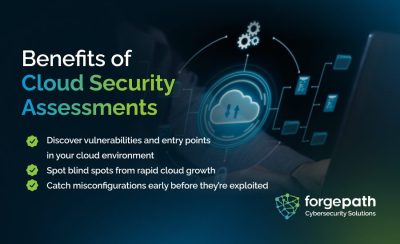
Cloud Security Assessments: Benefits, Checklist And Processess

Cloud Security Assessment: Key Takeaways A cloud security assessment identifies vulne…
Read Full Article
An infographic highlighting what’s included in AI pen testing, the tools used, and the top AI threats

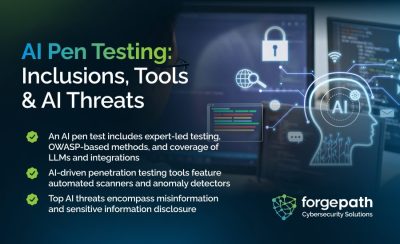
AI Pen Testing: Inclusions, Testing Tools & AI Threats

AI Pen Testing Explained: Key Takeaways Each AI pen test includes expert analysis, re…
Read Full Article
How AI enhances threat detection and response

What Is AI In Cybersecurity? What You Need to Know

Introduction: The Intersection of AI and Cybersecurity Artificial Intelligence (AI) is…
Read Full Article
Forgepath Penetration Testing

Introduction to Penetration Testing

A penetration test or pentest, is a simulated cyber-attack carried out by experienced sec…
Read Full Article