![A 101 Guide to Red Team vs. Blue Team [Top Exercises & FAQs]](https://forgepath.com/wp-content/uploads/2025/09/red-team-vs-blue-team-hero-image.jpg)
Red Team vs. Blue Team Explained: Key Takeaways
- A red team plays the role of a threat actor to uncover gaps in security systems
- A blue team is a group of people who defend the network
- Red and blue teams play different roles, but both are essential to a strong security posture
It might surprise you, but on average, it takes over eight months to detect and contain a data breach.
That kind of delay gives attackers far too much time, and it’s exactly why organizations need to put red and blue teams to work to test defenses and expose gaps.
We’ve put together this guide to help you:
- Understand the difference between red and blue teams
- Identify the must-have skills for both teams
- Explore the strategic value of each team
- See how Forgepath strengthens both sides
Red Team Explained
A red team plays the role of a real attacker, looking for gaps in your defenses and testing how far they can get without being caught.
These teams, often made up of ethical hackers or offensive security pros, use tactics like phishing, stolen credentials, and social engineering to:
- Break in
- Move through the network
- Access sensitive data
Their mission? Not just to break in, but to test how well your defenses hold up under pressure.
Blue Team Explained
Made up of internal security staff and incident responders, blue teams focus on stopping attacks before they escalate.
Their responsibilities include:
- Detecting threats
- Responding to intrusions
- Strengthening systems based on the findings of the red team
Red Team vs. Blue Team: What’s the Difference?
While red and blue teams approach security from different angles, they’re both essential to building effective defenses.
Understanding how they operate and complement each other can help your organization build smarter, more resilient defenses.
| Category | Red Team | Blue Team |
| Goal | Launches controlled attacks to identify vulnerabilities | Monitors and protects systems from active threats |
| Approach | Emulates threat actor behavior to test vulnerabilities | Focuses on prevention, detection, and incident response |
| Key activities | Conducts testing, phishing campaigns, and social engineering | Performs threat hunting, system hardening, and responds to incidents |
| Tools used | Utilizes custom exploits, red team frameworks, and adversary emulation platforms | Leverages SIEM solutions, IDS/IPS, firewalls, and continuous security monitoring |
| Security posture | Adopts an attacker’s perspective to breach systems | Prioritizes asset protection and threat containment |
| Result | Identifies vulnerabilities and tests security resilience | Strengthens defenses and reduces the impact of potential threats |
5 Skills Every Red Team Should Master
To succeed as a red team member, you’ll have to be creative, relentless, and maybe a little devious, since red teams need to mirror the tactics of threat actors to slip past defenses.
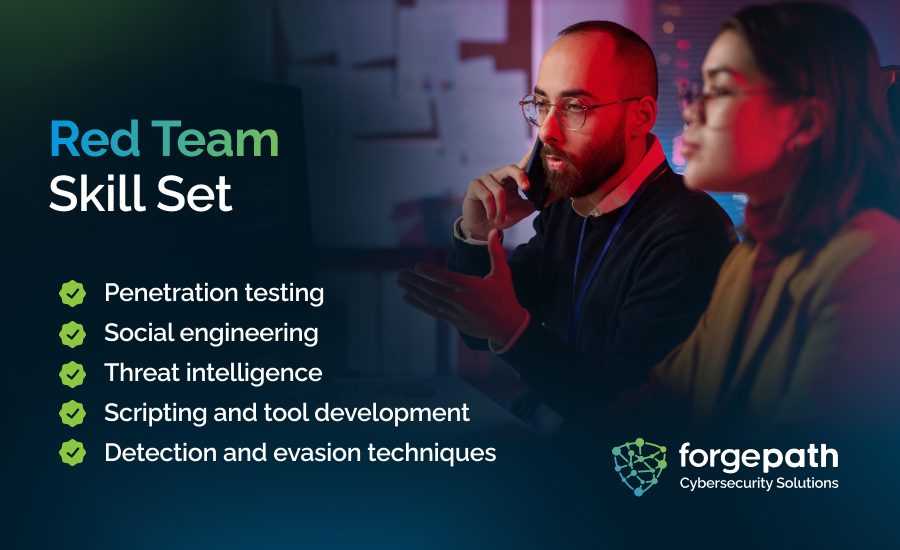
Red team work calls for advanced skills in:
1. Penetration Testing
They know how to find and exploit weaknesses across systems, networks, and applications, just like an actual adversary would.
The goal? To see how far they can get and where defenses might break down.
2. Social Engineering
Red teams utilize tactics like phishing emails, fake login pages, or even phone calls to test how employees respond to unexpected scenarios.
3. Threat Intelligence
Red teams stay plugged into the latest attack techniques, malware trends, and threat actor behaviors. This helps them build simulations that reflect what’s happening and not just theoretical threats.
4. Building Custom Tools
While plenty of tools exist, exceptional red teams often write their own.
Whether it’s a custom payload, script, or exploit, having coding skills means they can adapt quickly and operate in ways off-the-shelf tools just can’t replicate.
5. Detection and Evasion Techniques
Red teams study how SIEMs, IDS/IPS, and other monitoring tools operate, allowing them to design attacks that test whether defenses detect and respond to threats (or miss them entirely).
5 Core Blue Team Skills
The blue team’s job is to spot risks early, shut down attacks fast, and keep damage to a minimum.
But as adversaries grow more sophisticated, even the best teams face a constant uphill battle.
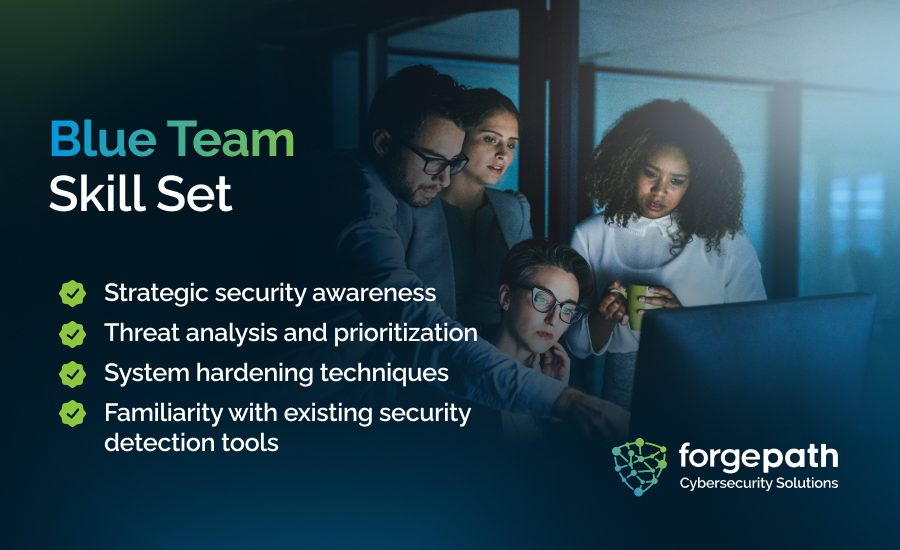
Their edge comes from a strong foundation in:
1. Strategic Security Awareness
Blue team members understand how people, tools, and processes come together to secure the organization.
They use that insight to guide their daily actions, making sure everything they do supports the broader security strategy.
2. Threat Analysis and Prioritization
Blue teams filter out false positives by analyzing logs, alerts, and telemetry data from tools like SIEMs and EDR platforms.
They zero in on high-risk activity, like lateral movement, privilege escalation, or unusual login patterns, so they can trigger a rapid yet focused response to the most serious threats.
3. System Hardening
Blue teams harden systems to make attacks harder to pull off.
That includes locking down vulnerable areas (like DNS settings) that attackers often exploit through phishing or web-based threats.
4. Tool and Alert Proficiency
Blue teams must stay fluent in the security tools already in place, whether it’s SIEM platforms, intrusion detection systems, or endpoint monitoring.
This deep familiarity allows them to fine-tune detection rules, reduce false positives, and respond to real threats before they spread or cause damage.
Red Team Cybersecurity Exercise Examples
Red teams often base their activities on the MITRE ATT&CK Framework, a widely used library of real-world adversary tactics and techniques.
It helps red teams design realistic, high-impact simulations and gives organizations a structured way to sharpen their defenses based on real threats and not just hypotheticals.
Here’s what a red team typically puts into action:
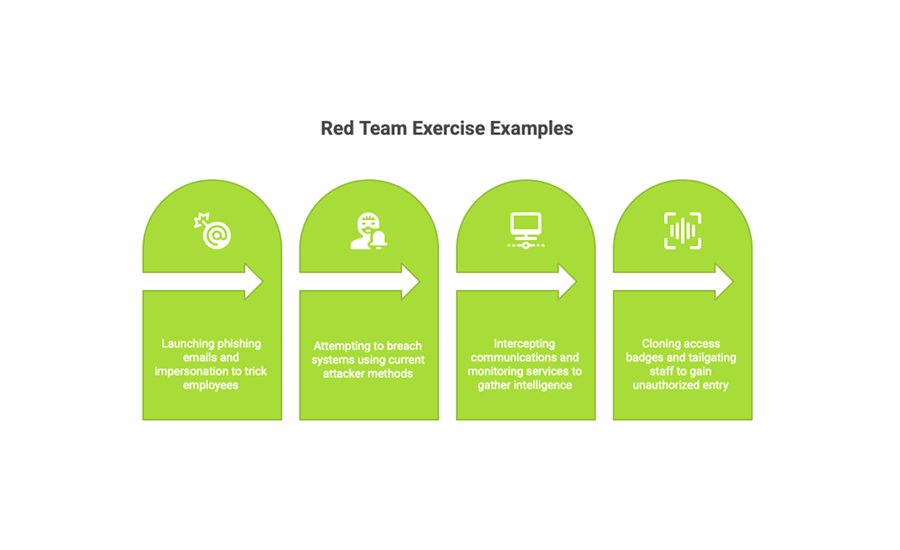
1. Social Engineering Campaigns
While social engineering is no longer the top threat according to Verizon’s 2025 report, it continues to be one of the most successful methods attackers use to gain initial access.
Red teams use tactics like phishing, phone-based pretexting, and in-person impersonation to test how easily employees can be manipulated into revealing credentials, clicking malicious links, or bypassing security protocols.
2. Real-World Penetration Testing
Red teamers attempt to breach systems using tactics that reflect current attacker methods, such as exploiting unpatched vulnerabilities, abusing misconfigurations, or leveraging weak authentication.
3. Network Reconnaissance
Red teams intercept internal communications and monitor exposed services to gather intelligence. They use this information to map the environment, identify weak points, and plan stealthy attack paths.
4. Cloning
In some cases, red teams clone employee access badges or tailgate staff to gain unauthorized entry to restricted areas, testing physical security controls alongside digital ones.
Blue Team Cybersecurity Exercise Examples
Blue team exercises help strengthen defenses, improve visibility, and ensure the organization can detect and respond to threats quickly.
These are the go-to tactics blue teams use:
1. Digging Into DNS
Blue teams look at DNS traffic and settings to spot anything unusual, like suspicious lookups or signs of a hidden communication channel.
2. Building a Baseline
Blue teams can create a reference point by studying normal network activity, blue teams. That way, when something strange happens, like unexpected data transfers or odd login times, it stands out.
3. Reviewing and Fine-tuning Security Tools
They regularly check and fine-tune security software like firewalls, SIEMs, and endpoint protection to make sure alerts are firing when they should and nothing important slips through the cracks.
4. Checking Perimeter Defenses
Blue teams validate that systems like firewalls, antivirus, and anti-malware are not only up to date but doing their job, blocking threats before they reach internal systems.
5. Limiting Access
They apply the principle of least privilege, giving users and devices only the access they need. This helps contain damage if someone gets compromised.
6. Segmenting Networks
Using micro segmentation, they break the network into smaller zones. That way, even if an attacker gets in, they can’t roam freely across the entire environment.

Why Red and Blue Team Exercises Matter
Red and blue team exercises reveal blind spots, strengthen defenses, and prepare your organization for real-world threats.
- Find hidden weaknesses: Red teams uncover vulnerabilities that routine checks often miss, giving your security team a clearer picture of where you’re exposed.
- Sharpen defensive skills: Blue teams learn from simulated attacks, improving how they detect, block, and respond to real threats.
- Improve incident response: These exercises give teams a chance to rehearse their response plans under pressure, so when a real incident hits, they know exactly what to do.
- Boost teamwork between teams: Red and blue teams work better when they understand each other’s tactics. These exercises encourage collaboration and build trust between both sides.
- Strengthen your overall security posture: Regular testing helps your organization stay ahead of evolving threats and adapt faster when gaps are found.
- Raise security awareness: These scenarios give everyone, from IT to leadership, a hands-on look at how attacks happen and what their role is in stopping them.
- Drive continuous improvement: When you regularly challenge your systems and teams, your organization can stay agile and prepared to respond to new and emerging attack techniques.
Explore Red Team and Blue Team Tactical Services at Forgepath
Whether you’re testing your perimeter or preparing your incident response team, Forgepath helps you simulate real-world attacks and respond with confidence.
Our Red Team Assessments, AI-driven penetration testing, and social engineering campaigns challenge your defenses, while our network segmentation and security architecture reviews strengthen your blue team’s ability to detect and contain threats.
Red Team vs. Blue Team: FAQs
Which team is better?
Neither. Red teams simulate attacks to find weaknesses; blue teams defend and respond. Together, they form a complete strategy.
Can I implement both red and blue teams at the same time?
Yes, you can (and should!) run red and blue teams together.
This collaborative approach, known as purple teaming, blends offensive and defensive tactics to test, refine, and strengthen your security posture through real-time feedback and continuous improvement.
What is a purple team?
A purple team bridges the gap between offense and defense. Instead of working in isolation, red and blue teams collaborate. This means sharing tactics, findings, and feedback in real time.