AI Pen Testing Explained: Key Takeaways
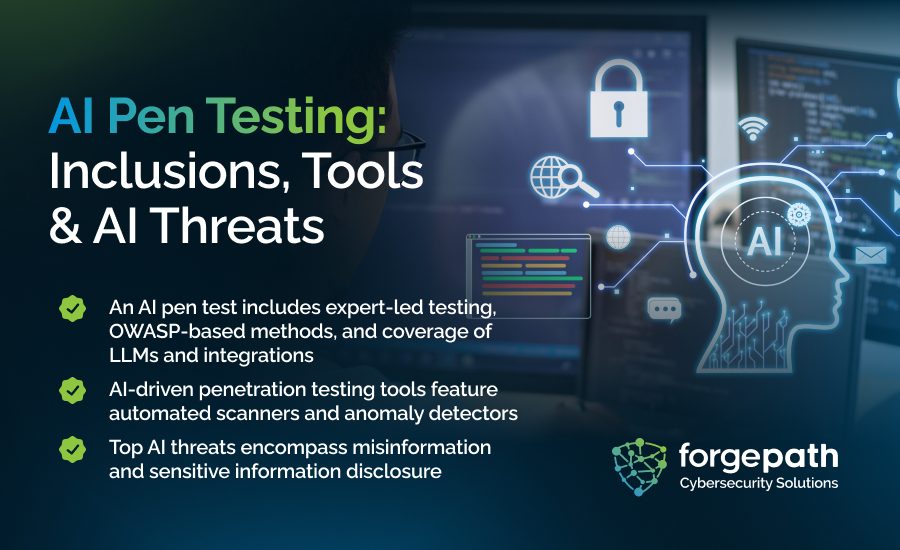
- Each AI pen test includes expert analysis, real-time visibility, OWASP-based methods, and testing across LLMs and their integrations
- AI-driven pen testing relies on tools like automated scanners, adaptive threat simulation models, intelligent anomaly detectors, and exploitation frameworks
- Among the top AI threats are misinformation and data leaks, risks that can damage trust, violate compliance, and mislead users
Penetration testing, also known as pen testing, is a core cybersecurity strategy that tests how well defenses hold up under real-world conditions.
AI penetration testing applies this approach to systems like secure machine learning models and chatbots so they can uncover vulnerabilities that could lead to unauthorized access, data leaks, or downtime.
In this guide, we will:
- Break down what’s covered in an AI penetration test
- Explore the essential tools behind AI-driven pen testing
- Gain insight into today’s most critical AI security threats
- Discover why Forgepath is the trusted choice for AI pen testing
What’s Included in AI Pen Testing?
AI helps with the early stages of penetration testing, especially during the scanning phase, by rapidly analyzing large volumes of data.
Each AI penetration test comes with:
- Expert penetration testers with verified credentials and specialized experience aligned with your specific AI use cases
- 24/7 visibility into testing timelines, findings, and progress via a secure platform
- Testing methodologies based on industry standards
- Capability to assess complex AI environments, from advanced applications to intricate system architectures
- Flexible testing frameworks for both standalone LLMs and integrated third-party tools or APIs
- A detailed final report outlining discovered vulnerabilities, severity levels, and recommended remediation steps
- One round of retesting, with an updated report reflecting resolved issues and outstanding risks
Common AI-Driven Penetration Testing Tools
AI-powered tools play specialized roles throughout the pen testing process, enhancing both speed and precision.
Let’s break down how these tools strengthen each phase of the testing process:
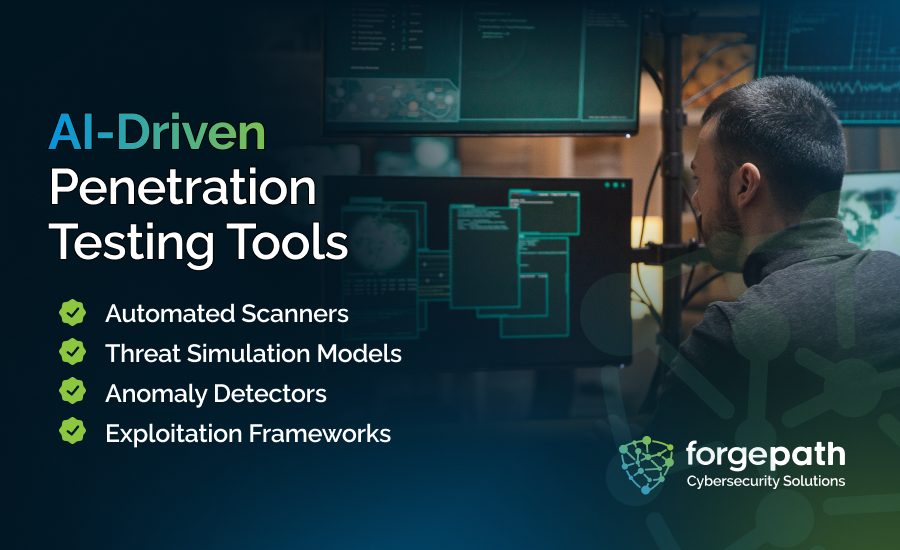
1. Automated Scanners
These tools use AI to quickly scan systems for known vulnerabilities, reviewing code and configurations to detect flaws that might expose your system to potential risks.
2. Threat Simulation Models
These AI-driven models create dynamic, context-aware attack scenarios that evolve in real time based on how the system responds, mirroring the adaptive strategies of real-world attackers.
3. Anomaly Detectors
Utilizing machine learning, these tools flag unusual behavior that could indicate a compromise.
For example, they can help detect:
- Login attempts from unfamiliar IPs or geolocations
- Abnormal data transfers during off-hours
- Sudden permission changes or configuration shifts
4. Exploitation Frameworks
AI-enhanced exploitation tools automate the process of simulating post-breach behavior, such as lateral movement or privilege escalation.
Understanding the Top AI Threats: OWASP’s LLM Top 10 Framework
As AI and large language models (LLMs) take on a bigger role in digital products, the security risks are growing just as fast.
To tackle these emerging threats, OWASP has released the LLM Top 10, a focused framework outlining the most critical vulnerabilities unique to generative AI systems.
1. Prompt Injection
Attackers manipulate inputs to override or redirect model behavior, potentially bypassing safeguards, exfiltrating data, or executing unintended actions that compromise system integrity.
2. Sensitive Information Disclosure
LLMs may unintentionally leak personal, financial, or proprietary data due to misconfigurations, poor prompt design, or lack of data sanitization, putting compliance and trust at risk.
3. Supply Chain Vulnerabilities
Third-party dependencies, such as open-source models, plugins, or LoRA adapters, can introduce malicious code or poisoned datasets, expanding the attack surface and eroding model reliability.
4. Data and Model Poisoning
Adversaries manipulate training or fine-tuning data to embed harmful logic, backdoors, or bias, undermining model outputs and creating persistent, hard-to-detect threats.
5. Improper Output Handling
LLM-generated content used without validation can lead to serious exploits like cross-site scripting (XSS), SQL injection, SSRF, or privilege escalation in downstream applications.
6. Excessive Agency
Giving LLMs too much control, such as unrestricted access to file systems, tools, or code execution, without appropriate safeguards can lead to unintended or high-risk operations.
7. System Prompt Leakage
Exposure of internal system prompts containing sensitive logic or authentication flows allows attackers to reverse-engineer control mechanisms and manipulate LLM responses.
8. Vector and Embedding Weaknesses
Retrieval-augmented generation (RAG) systems are vulnerable to embedding inversion attacks, poisoned vector data, and data leakage, jeopardizing context-aware model outputs.
9. Misinformation
LLMs can “hallucinate” facts, leading to false or misleading outputs. If left unchecked, these inaccuracies can cause reputational harm, legal exposure, and user safety concerns.
10. Unbounded Consumption
Without usage limits, attackers can exploit LLMs through excessive queries, causing Denial of Service (DoS), financial drain (Denial of Wallet), or even model extraction.
Key Benefits of AI Pen Testing
Penetration testing is a foundational element of any cybersecurity strategy.
It proactively tests the strength of an organization’s security posture by simulating real-world attack scenarios.
Here’s why AI security testing can help protect your systems and reputation:
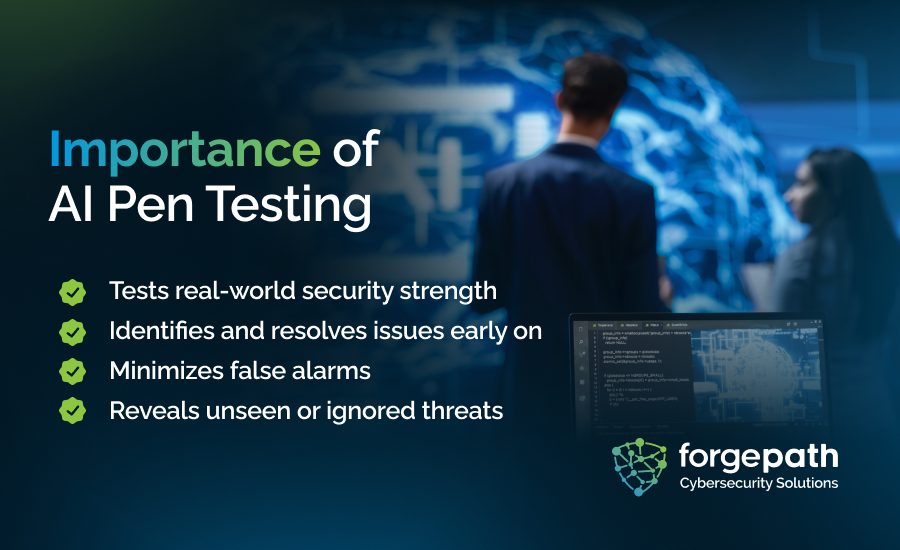
- Evaluates real-world defense readiness: Pen testing simulates known attack vectors and adversarial behavior to determine how well current security measures hold up under pressure.
- Identifies and mitigates vulnerabilities before exploitation: It helps uncover weaknesses in applications, networks, or infrastructure so they can be addressed before being exploited by malicious actors.
- Reduces false positives through AI-powered analysis: AI enhances security testing by contextualizing findings, improving the accuracy of threat detection, and minimizing time spent on irrelevant or low-risk alerts.
- Reveals hidden or overlooked risks: Advanced testing uses AI to mimic attacker tactics, techniques, and procedures (TTPs), exposing vulnerabilities that automated scanners alone might miss.
- Keeps pace with evolving AI-enhanced threats: Generative AI tools are increasingly used by attackers to craft more convincing phishing attempts and social engineering tactics. AI-assisted pen testing helps ensure your defenses adapt to these emerging threats.
- Combines human expertise with intelligent automation: The most effective tests integrate the creativity and judgment of experienced security professionals with AI’s speed and scale in scanning and analyzing vast attack surfaces.
- Validates response plans and staff readiness: Pen testing goes beyond technical assessments to evaluate how well your team responds to attacks, providing insights into training gaps and incident response capabilities.
- Delivers comprehensive, actionable reports: Organizations receive detailed reports outlining identified vulnerabilities, severity ratings (often using CVSS), tailored remediation steps, and, where needed, mappings to compliance frameworks.
Why Choose Forgepath for AI Pen Testing Services?
Forgepath comprises security experts trusted by top organizations to identify AI-specific vulnerabilities before bad actors can exploit them.
Whether it’s prompt injection, model misuse, or other emerging threats, our team replicates real-world attack scenarios across your LLMs, APIs, and AI infrastructure.
With deep experience in red teaming and adversarial testing, we deliver accurate, actionable insights that cut through false positives and help you strengthen your AI systems against potential risks.
AI Pen Testing Explained: FAQs
How does AI improve the effectiveness of pen testing?
AI models significantly boost the efficiency and accuracy of penetration testing by:
- Automating vulnerability discovery: Quickly scanning systems to detect common and complex security flaws
- Analyzing system behavior: Recognizing unusual patterns and interactions within AI models to flag potential risks
- Delivering context-aware insights: Helping testers understand the implications of vulnerabilities in real-world scenarios
- Minimizing false positives: Removing duplicate findings and focusing on the most important threats that need fixing
Who should conduct AI penetration testing?
Only seasoned cybersecurity professionals should perform AI-focused penetration tests. Ideal candidates include:
- Ethical hackers with hands-on penetration testing experience
- Security researchers with deep knowledge of AI model behavior and threat modeling
- Specialized security firms that focus on AI-driven systems and LLM vulnerabilities
These experts must understand both traditional security principles and the unique attack surfaces introduced by machine learning and generative AI technologies.
How often should your organization test your AI systems?
Since AI systems evolve rapidly and face constantly shifting threats, organizations should schedule regular penetration tests.
Testing frequency should depend on factors like data sensitivity, system complexity, and update cycles:
- Quarterly: For systems handling high-risk data or undergoing frequent changes
- Semi-annually: For lower-risk environments or more stable AI models